Introduction
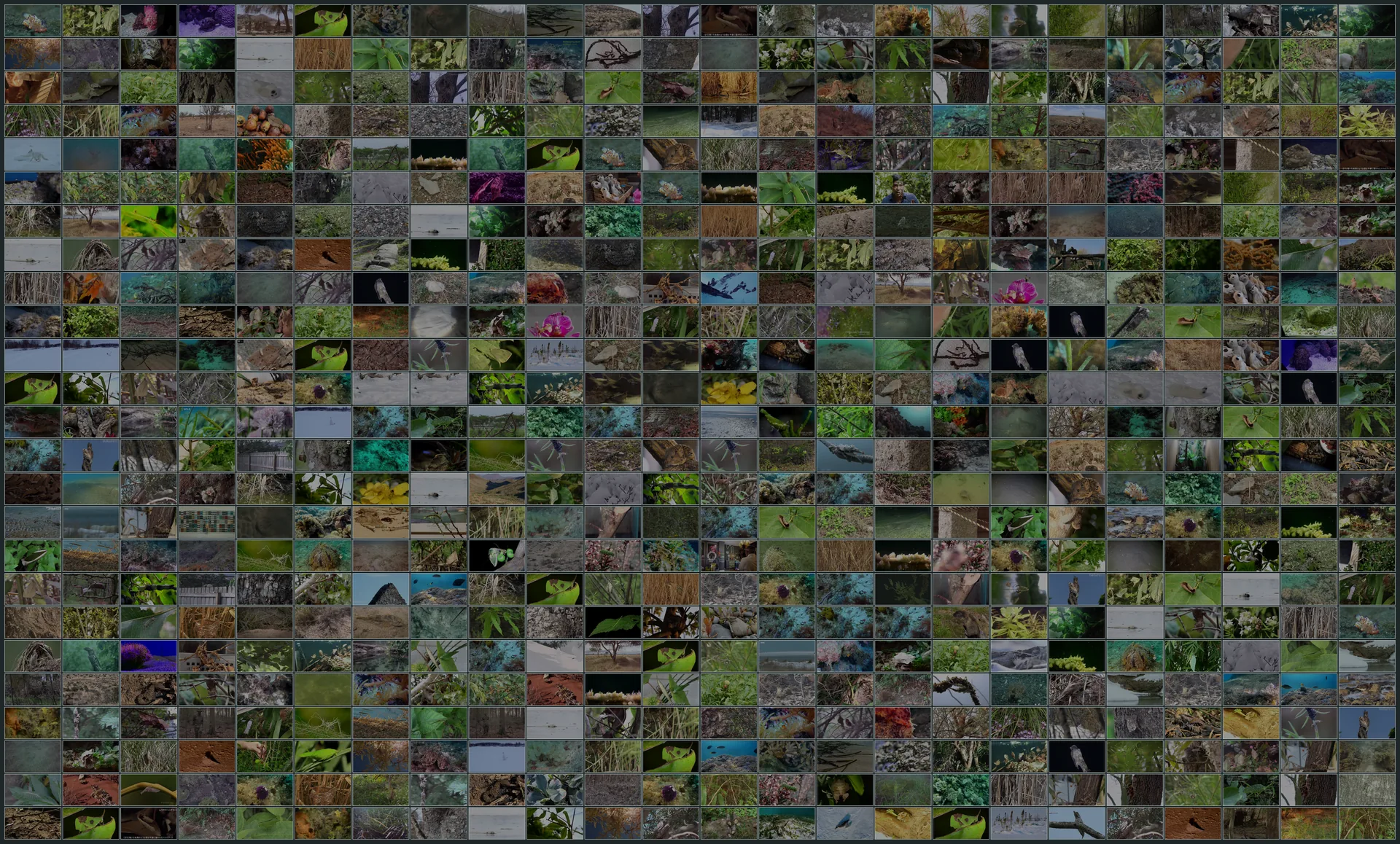
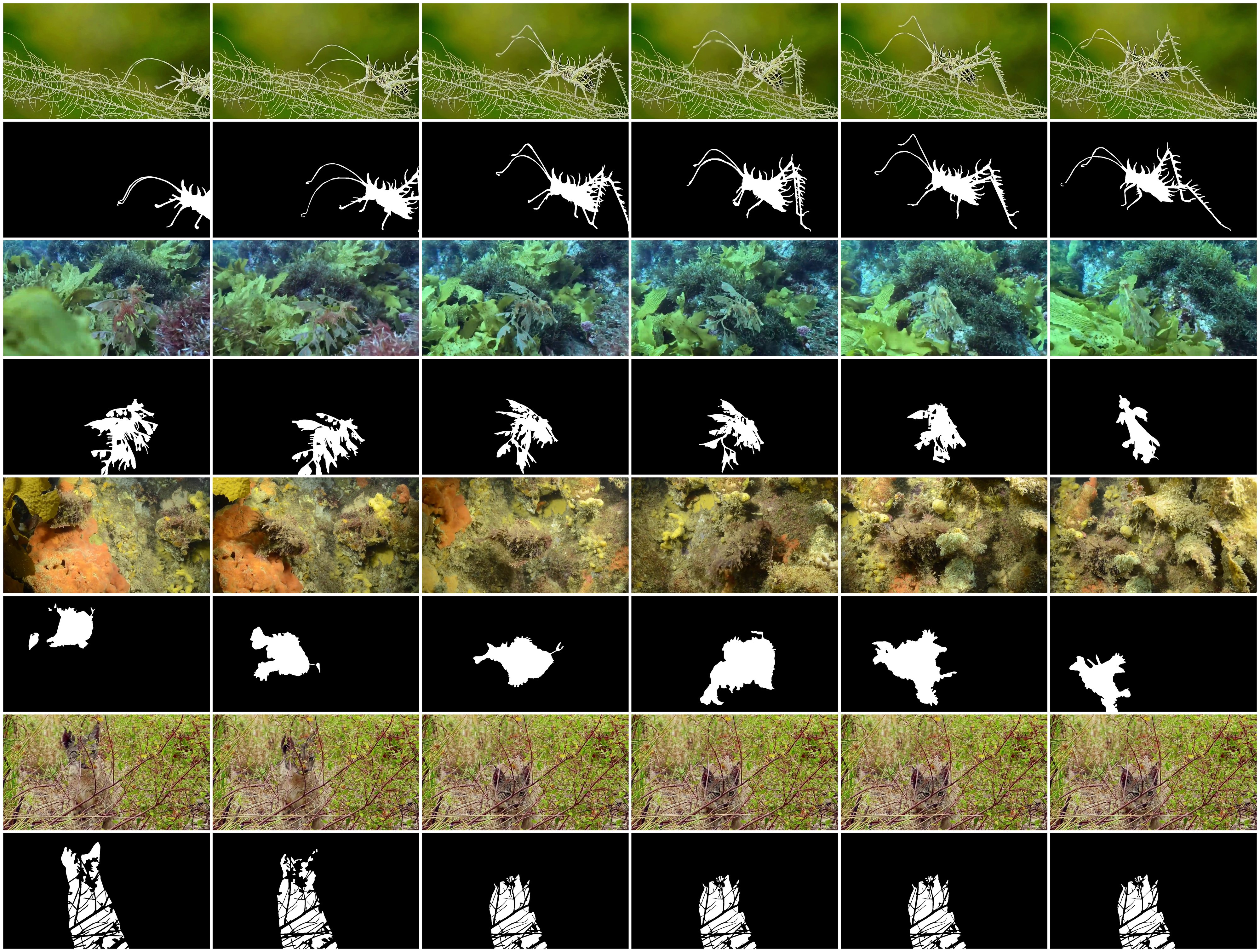
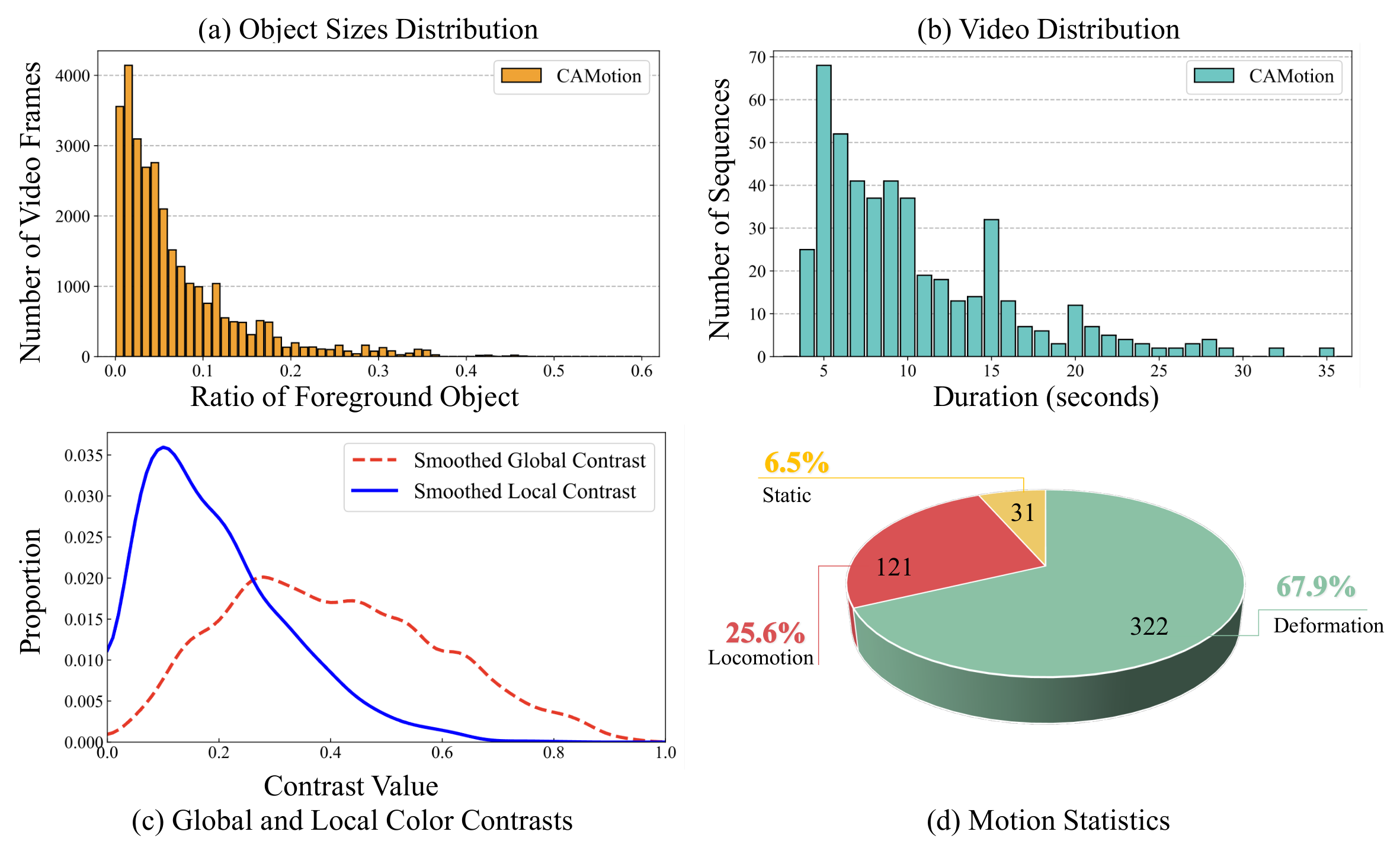
Discovering camouflaged objects is a challenging task in computer vision due to the high similarity between camouflaged objects and their surroundings. While the problem of camouflaged object detection over sequential video frames has received increasing attention, the scale and diversity of existing video camouflaged object detection (VCOD) datasets are greatly limited, which hinders the deeper analysis and broader evaluation of recent deep learning-based algorithms with data-hungry training strategy. To break this bottleneck, we construct CAMotion, a high-quality benchmark that covers a wide range of species for camouflaged moving object detection in the wild. CAMotion comprises various sequences with multiple challenging attributes such as uncertain edge, occlusion, motion blur, and shape complexity, etc. The sequence annotation details and statistical distribution are presented from various perspectives, allowing CAMotion to provide in-depth analyses on the camouflaged object’s motion characteristics in different challenging scenarios.
Statistics
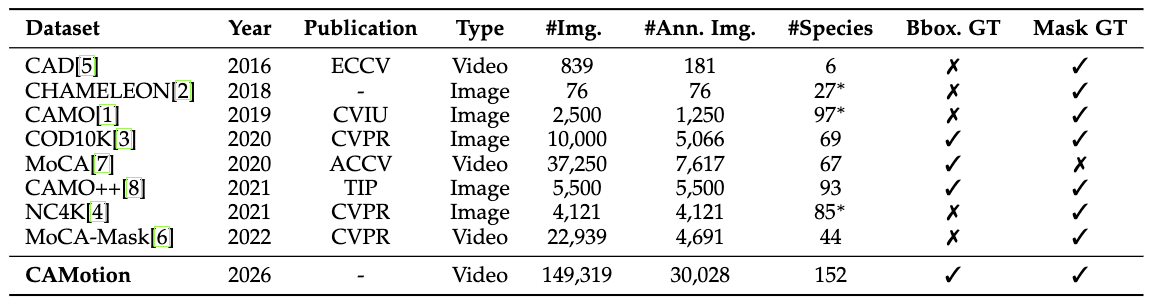
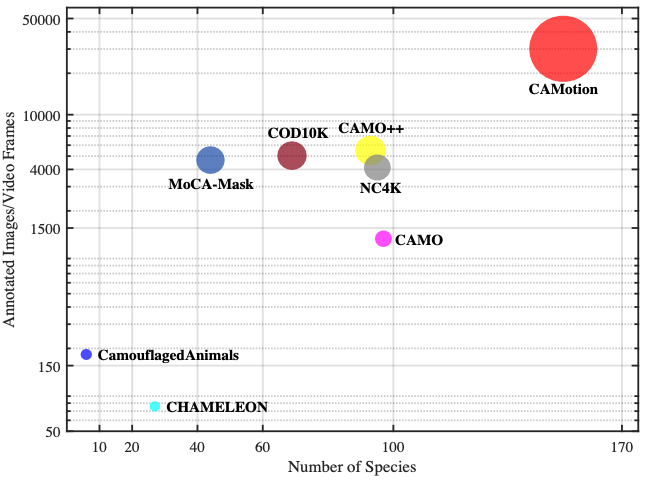
Statistic comparison with other camouflage datasets
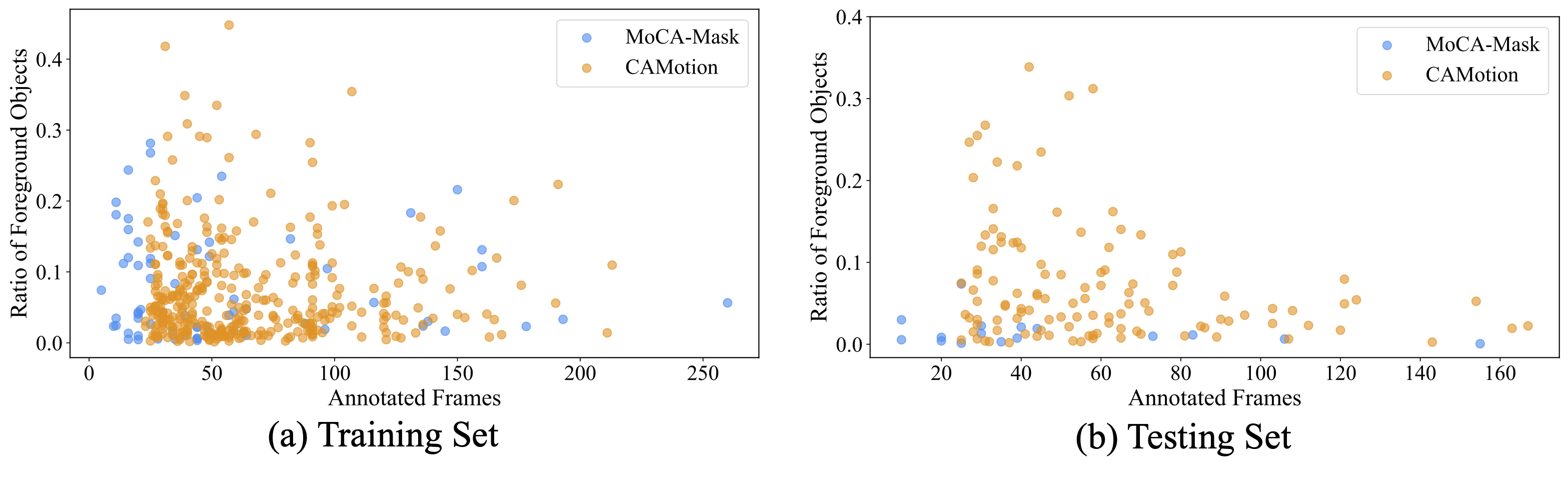
Dataset features
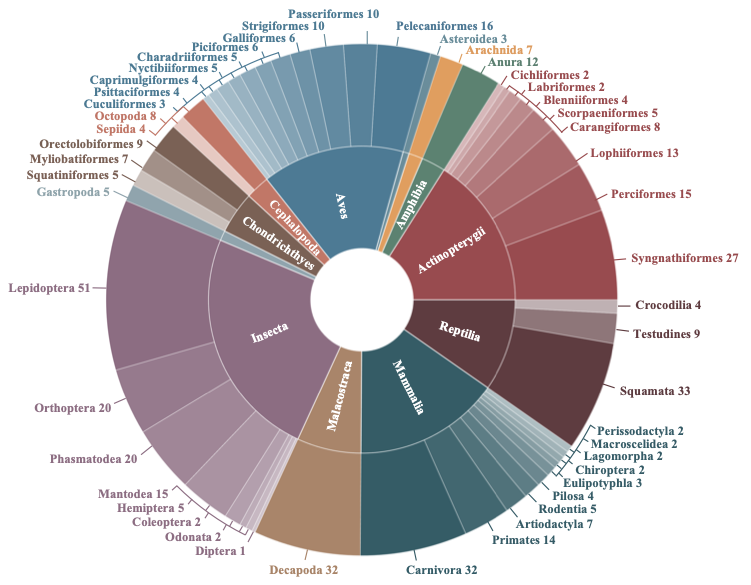
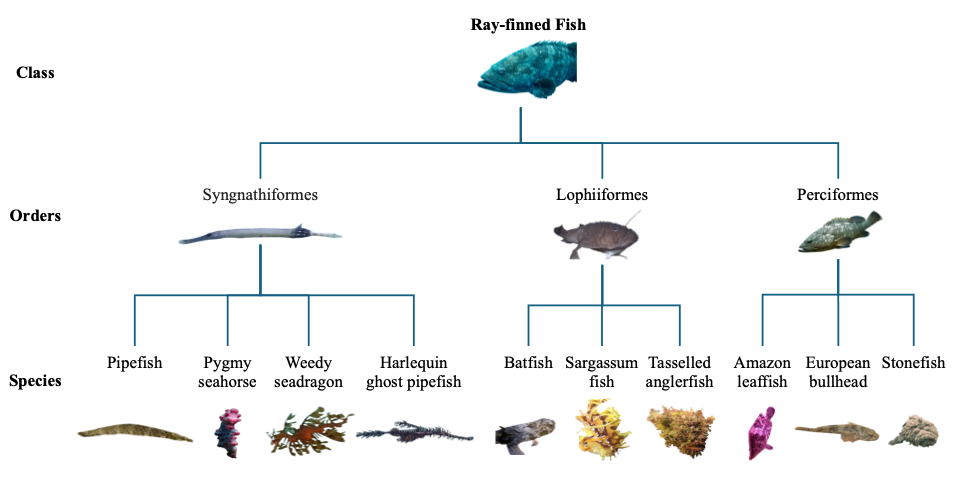
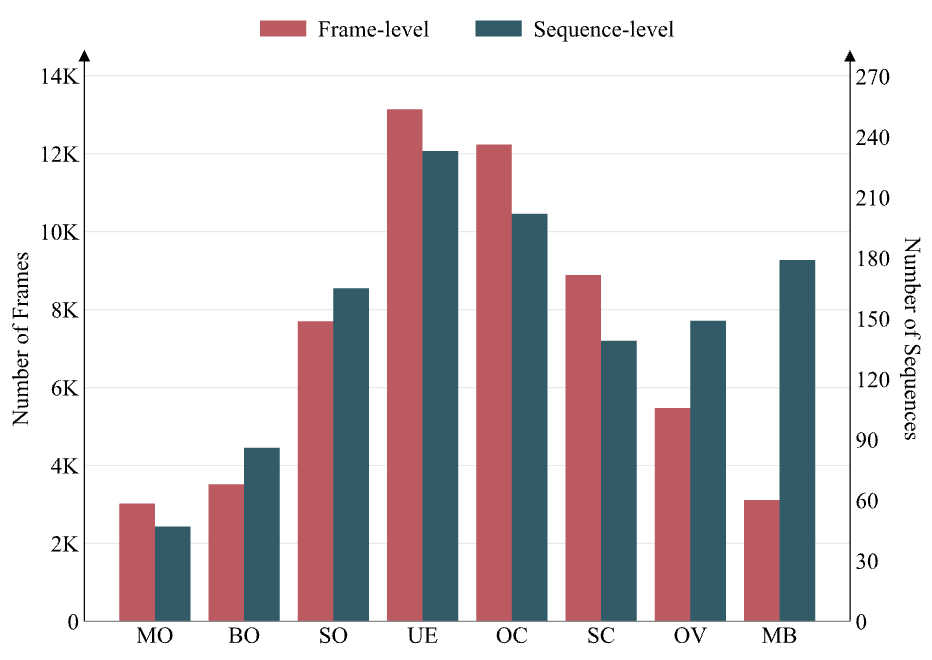
Tip: click to enlarge for details.
Demo
Evaluation
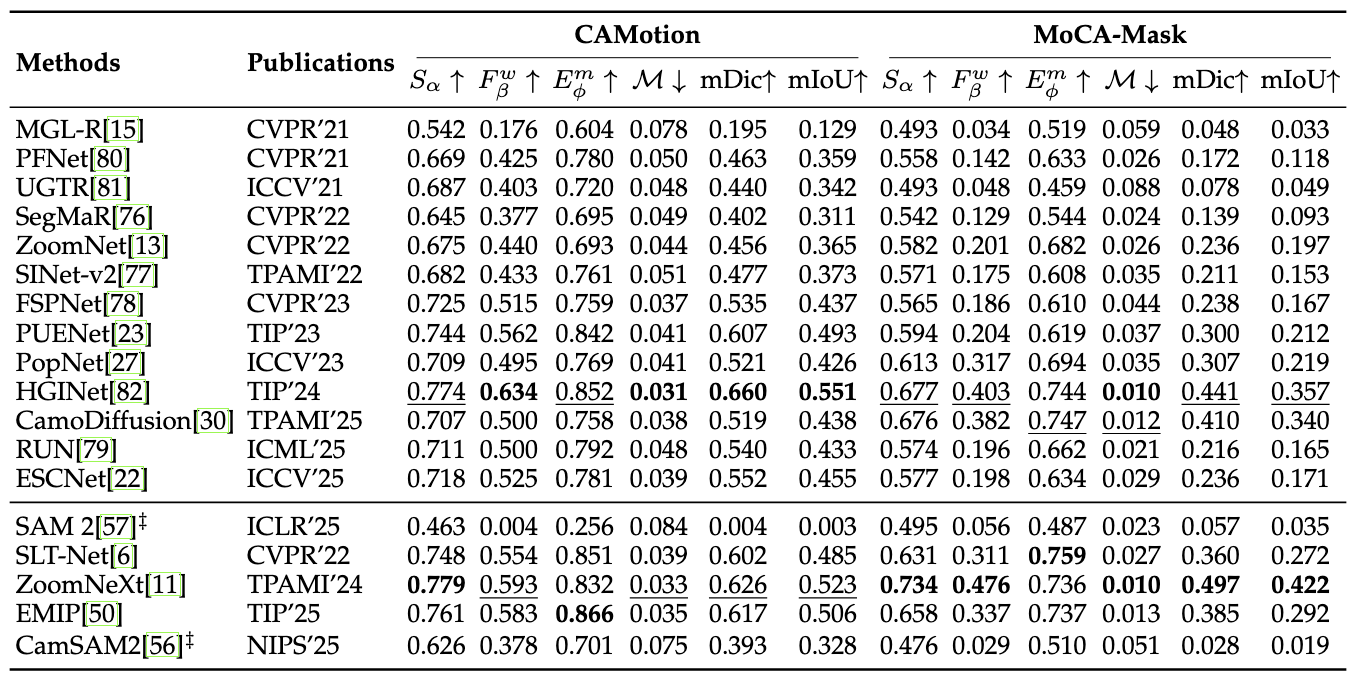
We conduct comprehensive experiments on the CAMotion dataset to evaluate the performance of 18 COD/VCOD models. Despite the promising performance of these models on existing COD datasets, these models exhibit a notable performance decline on the CAMotion benchmark. Both COD and VCOD methods still struggle to balance camouflaged object discriminative capability and temporal consistency. How to accurately identify camouflaged objects across video frames while mitigating error accumulation over time remains a crucial challenge.
- Metrics: S measure, weighted F measure, mean E measure, MAE, mean Dice, mean IoU.
TABLE 2: Quantitative comparison with 18 cutting-edge methods on CAMotion and MoCA-Mask testing datasets. Notes $$\uparrow/\downarrow$$ denotes the higher/lower the better, and the best and second best are $$\textbf{bolded}$$ and $$\underline{\text{underlined}}$$ for highlighting, respectively. $$\ddagger$$ indicates that the prompt input, i.e., the first-frame annotation, is removed during both training and testing for a fair comparison.
Dataset
Dataset Download
The dataset is available for non-commercial research purposes only. Please use the following links.


Depth and Optical Flow
The depth map generated by Depth Anything V2 and optical flow generated by GMFlow can be found at Google Drive and Baidu NetDisk.
Attributes
To facilitate in-depth analysis of camouflaged videos under various challenging scenarios, we categorize each camouflaged frame according to eight attributes, including uncertain edge (UE), big object (BO), multiple objects (MO), small object (SO), occlusion (OC), shape complexity (SC), out-of-view (OV) and motion blur (MB). The definitions of these attributes are provided below.
| Attr | Description |
|---|---|
| MO | Multiple Objects: image contains at least two objects. |
| BO | Big Object: ratio between object area and image area ≥ 0.15. |
| SO | Small Object: ratio between object area and image area ≤ 0.02. |
| UE | Uncertain Edge: the foreground and background areas around object have similar colors and textures. |
| OC | Occlusion: the object is partially occluded. |
| SC | Shape Complexity: object contains thin parts (e.g., animal foot). |
| OV | Out-of-View: some portion of the object leaves the camera field of view. |
| MB | Motion Blur: the object region is blurred due to the motion of object or camera. |
Data structure
CAMotion
├── TestDataset_per_sq
│   ├── African_twig_mantis_3
│   └── …
│
└── TrainDataset_per_sq
    ├── African_twig_mantis_2
    │   ├── BBox
    │   │   ├── 00000.txt
    │   │   └── …
    │   ├── Edge
    │   │   ├── 00000.png
    │   │   └── …
    │   ├── GT
    │   │   ├── 00000.png
    │   │   └── …
    │   └── Imgs
    │       ├── 00000.jpg
    │       ├── 00005.jpg
    │       ├── 00010.jpg
    │       └── …
    └── …
People
Siyuan Yao
Sun Yat-sen University Shenzhen Campus
Hao Sun
Sun Yat-sen University Shenzhen Campus
Ruiqi Yu
Nanyang Technological University
Xiwei Jiang
Beijing University of Posts and Telecommunications
Wenqi Ren
Sun Yat-sen University Shenzhen Campus
Xiaochun Cao
Sun Yat-sen University Shenzhen Campus
Citation
Please cite CAMotion if it helps your research.
@article{yao2026camotion,
  title={C{AM}otion: A High-Quality Benchmark for Camouflaged Moving Object Detection in the Wild},
  author={Siyuan Yao and Hao Sun and Ruiqi Yu and Xiwei Jiang and Wenqi Ren and Xiaochun Cao},
  journal={arXiv preprint arXiv:2604.08287},
  year={2026}
}